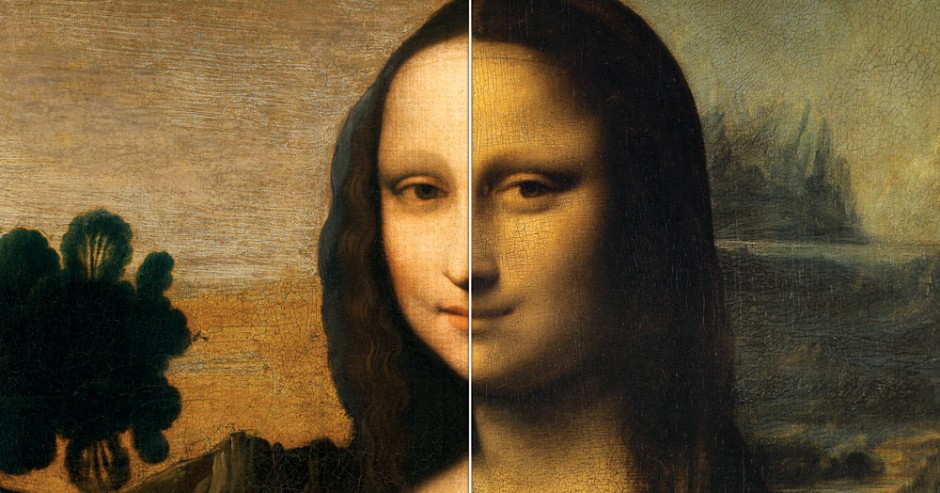
This section highlights similarities and the differences between the original and Louvre versions of Mona Lisa, and some of the copies that emanated from them:
- Clear similarities between the two authentic Mona Lisas are: the pose; the veil; the profiles; the hands; the clothing; the loggia setting and the foreground landscape; and the right elbow resting on the unseen arm of the chair.
- Clear differences between them are: the supports – one is on canvas, the other on wood panel; the overall compositions, including the fact that one composition has columns and the other does not; the obvious age difference between the subjects; the specific details and intended discrepancies of the knot patterns of the embroidery; the background landscape; the glazing technique specific to the Louvre version; the geometric construction of the designs; and the proportion of the subjects in relation to the overall sizes of the paintings; the presence in the earlier version and absence from the Louvre version of columns and appropriate shadowing at their bases; the difference in spacing between the eyes of the subjects.
- In 1550, and again in 1568, Vasari clearly identified that Leonardo left the painting “ … unfinished … ” The Louvre ‘Mona Lisa’, however, is completely finished, and was so when Leonardo showed it to the Cardinal of Aragon at Cloux in 1517. The small pen and ink drawing by Raphael of a young woman on a balcony with columns, dating from c.1504 and executed while he was in Florence observing Leonardo at work, is an important piece of evidence in itself. Most scholars concur that this drawing, and some of his subsequent paintings, were derived from a portrait of Mona Lisa being undertaken by Leonardo. It was evidently the original ‘Mona Lisa’, with its unique composition and set of flanking columns, that captivated and ultimately influenced Raphael. No other known painting by Leonardo features these characteristics and could have been seen by Raphael in the Great Master’s studio at that time in 1504.
- The existence of the columns and the application of appropriate shadowing strongly suggest the signature work by Leonardo. One observes the clear Leonardesque creation and fine execution of the lower section of the columns in the original ‘Mona Lisa’ contrasted with the rather poor renderings of the bases of columns partly visible in the Louvre version. The latter would likely not have been painted by Leonardo. The painted portion of the Louvre ‘Mona Lisa’ has never been cut down or trimmed, and therefore never did have columns.
- Both versions of the ‘Mona Lisa’ have generated their copies. The Louvre ‘Mona Lisa’ has been the basis for countless copies over hundreds of years. By contrast, any copy that employs flanking columns of classical design would likely have found its origin in the earlier ‘Mona Lisa’: for example, the Oslo ‘Mona Lisa’ is a direct copy of that original version. The mere existence of this painting only cements the earlier portrait’s place as an original painting by Leonardo. After all, why would an artist bother to copy a copy?
- The presence of unique embroideries only in the Louvre and earlier Mona Lisas, and the exceptional knot construction unique to the original ‘Mona Lisa’, strongly point to a Leonardo attribution.
In conjunction, these points show that:
- The artist intended from the outset that the works would be different from each other.
- Both paintings are original works, most likely by the same artist, and neither is a copy of the other.
- If Leonardo da Vinci painted one of them then he also must have painted the other.
Confirming the conclusion reached in the ‘Historical Evidence’ section, the innovative ‘Regression Project’ undertaken by one of the world’s leading forensic artists concludes that both Mona Lisa portraits are of the same woman, with a difference in age of about 11 years.