Few works of art have garnered as much attention from experts and the public as the ‘Mona Lisa’ in the Louvre Museum. By contrast, the earlier version has spent much of its existence hidden from view. Despite this, on the few occasions the painting has been available to be viewed, significant expert opinion has been recorded.
It is fair to say that attributing a painting to Leonardo da Vinci with certainty is one of the most difficult tasks in the field of Old Master paintings. To date there are about 18 to 20 paintings “more or less” attributed to Leonardo. One states “more or less” since there is not even one painting about which all the recognized Da Vinci experts agree. It is even disputed whether some parts of the famous ‘Mona Lisa’ portrait in the Louvre are not by the master. Any statement about a work of Da Vinci comes with a risk to one’s professional reputation. One famous expert said that attributing a painting to Leonardo is like “holding in one’s hand a burning iron rod.”
Nonetheless, it is generally accepted that he did paint all or at least the essential parts of those paintings that are currently attributed to him. In the case of a Da Vinci portrait, an attribution is generally agreed upon if the artist painted only the face, while some experts argue that it is even enough if Da Vinci had simply conceived the structure of the painting.
It should be noted that some of Leonardo’s pupils and followers had great talent. The well-known ‘Lady with an Ermine’ and ‘La Belle Ferronière’ represent only recent attributions to Leonardo, having previously been attributed to pupils for almost 400 years.
Professor Jean-Pierre Isbouts says, “Every interpretation is subject to subsequent dispute. When you look at dating, when you look at authorship, when you look at provenance. So I think it’s just part of the world we live in that Leonardo scholarship happens to be a debating society whether you like it or not.”
So, what are the key elements that would indicate that a work is by Leonardo authorship?
Historical Evidence
The history must be right. Given that the attribution of the Louvre ‘Mona Lisa’ is beyond doubt, in order to consider a Leonardo attribution for the earlier version, it is essential to first establish that Leonardo did, in fact, paint two Mona Lisas. There should be evidence suggesting that Leonardo worked on more than one version, or that another version was recognised by art experts and historians early on.
In the case of the original ‘Mona Lisa’, there is a well-documented record of an unfinished portrait of a Lisa del Giocondo, which was commissioned by her husband, Francesco, around 1503. This portrait has side columns, as sketched by the artist, Raphael, and depicts a youthful woman, as described by Giorgio Vasari. These important details are not typically associated with the version that’s in the Louvre. The Louvre painting is also known to have been commissioned closer to 1513, and by Giuliano de Medici, not Francesco del Giocondo.
Examining the body of historical documentation, acknowledging two completely separate commissions, and understanding Leonardo’s regular practice of performing multiple works on the same theme, the facts strongly suggest that Da Vinci did paint two works on the subject of Mona Lisa.
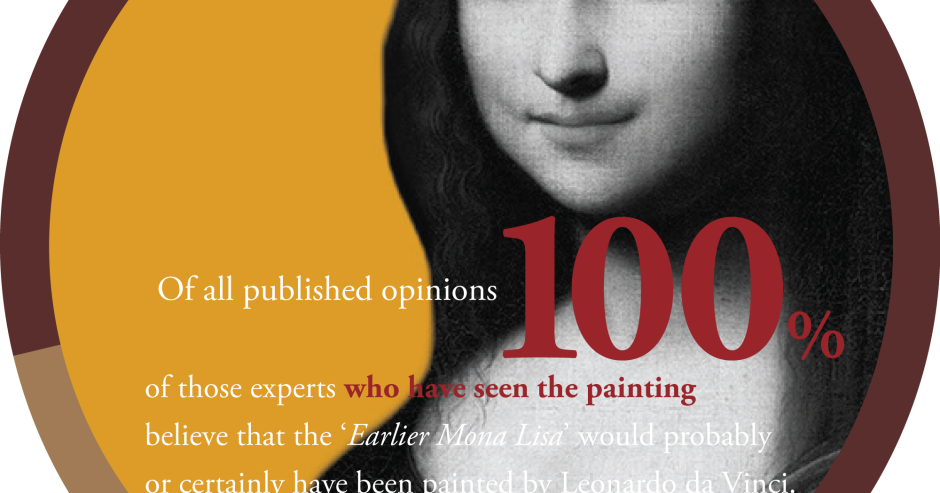
In 2017, Gérard Boudin de l’Arche following extensive research confirmed that Leonardo da Vinci painted two Mona Lisas ten years apart. In fact, in all published opinions on the matter, nearly 100% of all experts agree that there were (or at least could be) two versions.
Science & Materials
The scientific results should not reveal any factor that would make the work inconsistent with Leonardo on the grounds of dating, pigments used or physical structure. As Lumiere Technology’s Pascal Cotte states, all tests on the earlier ‘Mona Lisa’ show that it conforms.
Though few works attributed to Leonardo are on canvas, it should be noted that some experts believe as many as half of Leonardo’s works are lost or missing, some or even many of which may have been painted on this support. Additionally, by the early 1500s – the purported date of execution of the original ‘Mona Lisa’ – Leonardo had over 30 years of experience working with fabric supports. Examples of such work can be seen in his early drapery studies. It is also well known that Da Vinci was an eternal experimenter and innovator, and it should therefore come as no surprise that he tried his hand on this material. Perhaps most importantly, Leonardo devoted an entire section to painting on canvas in his Treatise On Paintin, and we know that everything he recorded came from his personal experience, so it is obvious that he experimented with painting on canvas.
The results of extensive scientific analyses of the painting materials and the canvas support, all suggest that they were indeed available to Leonardo in the early 1500s. [See
Comparative Examination
It is necessary to determine whether the earlier ‘Mona Lisa’ displays the hallmarks of the great master.
This in of itself does not establish an attribution, but it is necessary to verify that it is an original work and not simply a copy of the painting in the Louvre. Though the two Mona Lisa paintings are similar there are important differences, for example their overall compositions, their backgrounds, the sitting angles of the subjects, the apparent age of the subjects, the sizes and materials of their supports, the flanking columns, the embroideries, as well as other aspects. In addition, analysis of the earlier ‘Mona Lisa’ has revealed underdrawings and the painting has extra detail in its lower section. All of this indicates that it is an original work and, in the words of the much-respected art critic Paul Konody, “It is in no sense of the word a ‘copy’, but varies in important points from the Paris ‘Mona Lisa’.”
Connoisseurship
We must look at the painting as would an experienced connoisseur who can identify Da Vinci’s style and characteristics. We have already examined the statements by the experts of the 1920s. Most of today’s experts and historians share that same level of enthusiasm towards the original ‘Mona Lisa’. As Isbouts reflects: “ … she glows. And all the pink tones and hues that Giorgio Vasari writes about are patently visible … That wonderful chiaroscuro, that interplay of light and shadow … there simply isn’t any other artist who could have created it.”
Professor Atila Soares agrees: “ … the face, the hands … the whole atmosphere of the painting … you don’t see that in other versions or paintings that copy Da Vinci.”
Admiring the complexity and customization of the geometric proportions, Alfonso Rubino believes that it could not have been painted by another person: “Given the date of the first commission, if the earlier ‘Mona Lisa’ is false, then all the works of Leonardo are false.”
Professor Alessandro Vezzosi, arguably the most credible authority on the subject of Mona Lisa today, declared “Finally, when I got to see the original, even more than the emotion, I found a character that was inviting me to a dialogue with her gaze and with that certain smile …”
View of the Experts
The latest survey of all known published opinions reveals that the majority of experts believe Leonardo painted (or is at least likely to have painted) the original ‘Mona Lisa’. In chronological order of publication, those experts are:
Hugh Blaker, Paul Konody, John R. Eyre, Giulio Cantalamessa, Commendatore Cecconi, Arduino Colassanti, Commendatore Marini, Anto Sciortino, Cesare Segre, Ludovico Spiridon, San Martino di Valperga, Adolfo Venturi, R.H. Wilenski, A.C. Chappelow, Henry F. Puliitzer, John F. Asmus, Carlo Pedretti, Alfonso Rubino, Atila Soares, Jean-Pierre Isbouts, Albert Sauteur, Salvatore Lorusso, Andrea Natali, Jessica Elford, Vadim Parfenov, Gerard Boudin de l’Arche and Jason Halter.
Of the four experts who have gone on record to deny a Leonardo attribution, none of whom have seen the painting in person, their main objections are as follows:
- “Leonardo would not have painted on canvas.”
The simplest way to answer this is to point out that Leonardo da Vinci’s most famous Treatise, On Painting, has an entire chapter dedicated to “The Mode of Painting On Canvas”. The original ‘Mona Lisa’ conforms perfectly to the instruction written in that Treatise. Further evidence of Leonardo’s use of canvas can be seen in his ‘Drapery Study for a Seated Figure’, on display at the Louvre.
- “There is no evidence that Leonardo painted two Mona Lisas.”
The historical evidence concerning the two commissions in indisputable. The earlier ‘Mona Lisa’ is a portrait commissioned around 1503 by Francesco del Giocondo, of his wife Lisa. The Louvre version, finished with a glazing technique Leonardo didn’t develop before 1508, is the painting commissioned over a decade later by Giuliano di Medici. The scientific evidence proves the Louvre portrait cannot be the version witnessed by Vespucci in 1503, sketched by Raphael in 1504, and so vividly described by Vasari in both editions of his ‘Vite’.
- “The earlier ‘Mona Lisa’ is a copy.”
There are innumerable glaring differences between the original and Louvre Mona Lisas that rule either out as a copy of the other. Both paintings clearly exhibit autograph characteristics of Leonardo da Vinci. Notable known copies, like the Oslo ‘Mona Lisa’ are copies not of the Louvre painting, but of the earlier ‘Mona Lisa’.
- “The face looks too good.”
It was suggested the face was so exquisite, it much have been recently painted. The extensive scientific evidence, including reports relating to overall condition, restoration, dating, pigment and spectral analyses, demonstrate that this is impossible. Three carbon dating tests have all placed the painting of the earlier ‘Mona Lisa’ in line with dates Leonardo painted the portrait of Lisa.
- “The painting does not “look” like a Leonardo work.”
This line of criticism is largely in reference to the background of the painting not being ‘Leonardesque’. Given Leonardo’s practice of delegating less important section of his works to assistants, this in no way negates a Leonardo attribution. Furthermore, the historical evidence more than suggests that the original portrait of ‘Mona Lisa’ Lisa del Giocondo was left unfinished.
More recently, two recent peer-reviewed academic papers out of Bologna Italy, published in 2015 and 2016, have confirmed the attribution of the earlier ‘Mona Lisa’ to Leonardo da Vinci.
Until now, it has been believed that science cannot determine an attribution. However, new technologies are challenging thoat belief.
Prof. John Asmus, a key pioneer in developing the fields of Carbon C14 dating, art conservation and spectral imaging, has pioneered a new scientific method to identify artists by using the brushstrokes to creating a histogram ‘fingerprint’ of the artist. Having applied his technique to the Mona Lisas, Asmus concludes: “… it’s 99% certain that the two Mona Lisas were done by the same artist.” This conclusion is of vital importance. The implication being that denying the original ‘Mona Lisa’ a Leonardo attribution is equivalent to denying the Louvre painting the same attribution. In the words of Professor Asmus: “As to whether people who will refuse to accept the contention that the earlier ‘Mona Lisa’ is by Leonardo or not, my experience is there will always be people who will object to a theory like that. There are still people around who object to the spherical earth who maintain that it’s a flat earth.”
Given the most recent developments relating to the original ‘Mona Lisa’, and the support it has gained in recent years from the experts and the art community, the Mona Lisa Foundation has no doubt that the facts presented here are pervading into all realms of connoisseurship and scientific proof, leading to what is only a matter of time – the universal acceptance of this great masterpiece as the original ‘Mona Lisa’ by Leonardo da Vinci.