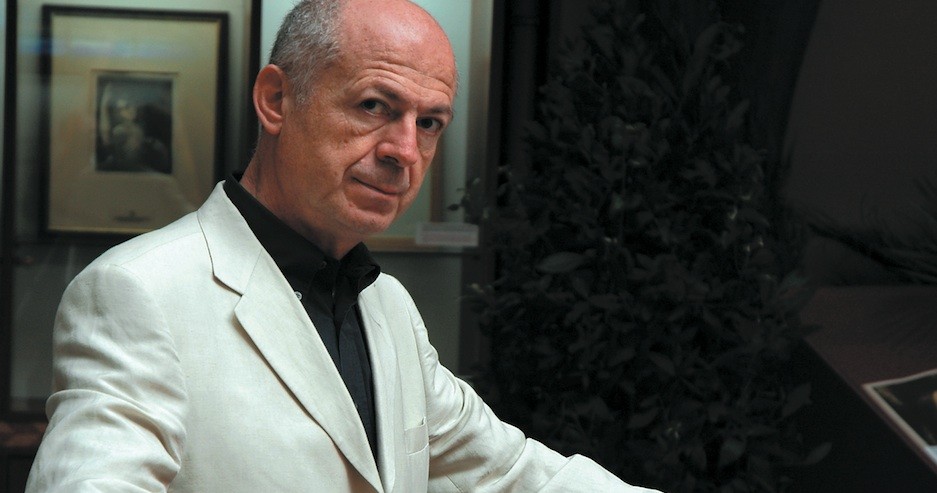
Speech by Alessandro Vezzosi
Geneva, September 27, 2012
Director of the Museo Ideale Leonardo da Vinci, Vinci, Italy.
Note: Alessandro Vezzosi is recognised as one of the most influential living experts on Leonardo da Vinci, and arguably the leading authority on Mona Lisa. This is the speech he gave at the occasion of the presentation of the painting to the international media.
I take the floor to present fairly briefly the events and the reasons that brought me here and to inform you about the ongoing research on the ‘Isleworth Mona Lisa’. Such research is part of the extremely complex studies on ‘Monna Lisa / Gioconda’ that are being carried out with the Archivio Leonardismi of the Museo Ideale Leonardo Da Vinci and under the auspices of the Armand Hammer Center for Leonardo Studies of the University of California, Los Angeles, directed by Carlo Pedretti.
Geneva is not only an important free port for the arts. It is also a university city, whose Library holds the ‘De Divina Proportione’ manuscript by Luca Pacioli for Ludovico il Moro, with illustrations drawn by Leonardo. Many works of art are kept in this city’s vaults, while our calling is – inter alia – to rediscover, to publish and to exhibit works of art hitherto unknown and inaccessible.
I started the Archivio Leonardismi forty years ago, gathering very diverse documents – from arts to mass media over five centuries – concerning Leonardo’s works and those of his circle. Every day, more and more, something new appears and today thousands of images make up the “Mundaneum Gioconde” – which is still growing. In 1981, I curated in Vinci the first exhibition of Leonardismi, which already presented the documentation on the ‘Isleworth Mona Lisa’ with Henry Pulitzer’s book “Where is the Mona Lisa?”, which raised much attention, as well as Marcel Duchamp’s ‘Joconde L.H.O.O.Q.’ and ‘Rasée’ which raised much controversy. In 1988, as curator of the Florence exhibition “Leonardo Lost and Found”, I presented a much commented interpretation by Carlo Pedretti and André Chastel concerning the notes about the ‘Gioconda’ in the “Diary” written by Antonio De Beatis – relating the visit by Cardinal Luigi of Aragon to Leonardo in Amboise in October 1517.
The new hypothesis, based also on elements of style, was that the Louvre’s ‘Gioconda’ did not represent the Monna Lisa del Giocondo described by Vasari (who eventually – among debatable observations – was at the origin of the name for the Louvre’s masterpiece and its disputed dating to 1502-1506) but was painted for Giuliano de’ Medici around 1514.
This suggested another hypothesis, which coincided with the quotation by Gian Paolo Lomazzo in his ‘Trattato’ of 1584: the existence of two distinct paintings (‘Gioconda’ and ‘Monna Lisa’), two portraits that I have been looking for passionately since then.
As time went by, I realized that there are some fundamental aspects concerning the Louvre’s portrait – that masterpiece that is the most painting in the world – that are not really known with certainty, such as its dating, the identity of the person who commissioned it and that of the person it represents.
In 1991, an archival discovery revealed that the inventory of Salai’s properties at the time of his death mentioned a ‘Gioconda’ for the first time. Someone thought – unlike myself – that it was the Louvre painting. However, many suppositions may be possible since the painting is only mentioned and not described or reproduced.
In 2005-2007, news were published about the exceptional discovery at the Heidelberg Library of a gloss written by Agostino Vespucci in the Autumn of 1503, a note to be interpreted in the sense that Leonardo painted only the head of a portrait of “Lisa del Giocondo”.
Following the publication of his latest book, The Gioconda Lost and Recovered, Gérard Boudin de l’Arche explains:
“It is the excellent TV show by the BBC “Secrets of the Mona Lisa” presented by Andrew Graham Dixon which sparked my interest in the ‘Gioconda’ portrait, because this show was able to reveal one of those secrets : there was evidence of the existence of another portrait of the ‘Gioconda’ painted by the Italian master. Therefore, a sort of police investigation through the past had to be undertaken both in Italy and France to find out.
Pieces of evidence, some very recent, led me to focus on a portrait rediscovered in England at the beginning of last century, improperly named the “Isleworth Gioconda“. There were two paintings and two sponsors : Giuliano de Medici and Francesco del Giocondo. The Isleworth painting was the first one begun in 1499 or 1500. The second one some years later. No less than two stages of inquiries were necessary to bring about the essay The Gioconda lost and recovered which tells, the very likely, up-to-date story of those two portraits. So we may confirm now that two portraits appeared to have been painted by Leonardo: actually one in the Louvre Museum in Paris, the second (or, really, the first) the earlier ‘Mona Lisa‘ as presented by the Mona Lisa Foundation. ”

Professor Vezzosi inspecting the condition of the earlier ‘Mona Lisa‘.